On the 22d of March I went to the conversation with filmmaker Sally Potter at The Wapping Project / Bankside London and I had the great pleasure to hear Potter talk about her film work over the years, see the movie the London Story and ask her a few questions about her working process.
In the beginning of their conversation Evans and Potter talked about Potter’s affinities with London where she’s originally from. What still attracts her to it is the rackety nature of London. Showing the London Story, (made in 1986 using an American Express Card to fund it), illustrated the imagined London as it is portraited to the world and the actual London. In this short film I found myself once again pleasantly confronted with the music of Sergei Prokofiev as I have mentioned his grip on my visual eye in my written document of my short film CANVAS.
They briefly touched upon the subject of the extreme low numbers of women filmmakers in the film industry (UK and abroad) where Evans mentions an article written by the African writer Chimamanda Ngozi Adichie in The Guardian.
She further talked about how film has a risk averse culture in which film somehow has to survive a clash market. She said the way to deal with this is to not think of it as a negative but to think of it as having a rather stringent effect. “Any kind of adversaries can become a springboard for finding new vocabularies.” She finds herself having to fight for each film, project by project, no matter what project she had done before. “Starting at the beginning every time is an excellent principle,” this is her humoristic take on her philosophy to deal with this particular situation over and over again.
A few of her thoughts on filmmaking really resonated me:
Where and how you choose to film, what you choose to look at and the way you choose to situate yourself, is in fact creating worlds, rather than inhabiting them. As a filmmaker any location is where a film could be: inside or outside. What you film is not necessarily what it seems to be.
Deciding to work first. Not answering email, not washing-up or any other attractive propositions for the day.
The key with survival is to give up on the notion of security and support. There won’t be any.
What you have to be propelled by in any of the arts is a real feeling of longing. It’s key to choose a project in which you feel a deep sense of believe and necessity, even if nobody else beliefs in what you’re doing for ages and ages, which is the norm.
“I don’t want to talk to myself; I really do want the film to land in other people’s consciousness, in their heart and their souls to resonate.”
I asked the questions:
Coming from a scenographic background in dance theatre I have an idea of how a film process can work. As a designer, I’m often asked quite late into the making process in which the concept is then already formed. During my current Master I found myself reacquainted with filmmaking, which is really liberating for me since it allows me to start at the beginning of a concept. I now wondered where something like cinematography comes into a filming process when you as a director are writing? When do you ask people to come and join you?
Potter: “The cinematographer is the eye, the point of view, is the gateway, is the portal, is the frame, is everything in a sense that is carrying what the audience is allowed to see through the frame. I usually build up, first of all, a huge bank of imagery when I’m working on a film, so I can discus with the cinematographer I decide to work with and the production designer and costume designer and everyone else, this, if you like, ‘bank’ of references or inspiration. So there is already a feeling for a look.
With Ginger & Rosa I did a lot of drawings and acuminated many photographs and then took photographs of the actors in rehearsals. So the language, the look, the feel of the film then starts to build up in the working process.
But also choosing whom to work with as a cinematographer is absolutely quite as important just as one is choosing the actor. I look upon hour and hour of work of different cinematographers if I don’t jet know whom to work with. After meeting them I work shoulder to shoulder with the cinematographer, literally glued to the shoulder as we try to find, try to see the material, the world of the film itself. To start seeing with the same pair of eyes. That relationship is a very exciting one.
Occasionally I shoot the film myself, and that is wonderful, because then I have a really direct relation with the actor straight across the camera. I think if you have grown as an independent filmmaker as I did, originally doing everything yourself like shooting, editing, costumes, etc., you’ll have a good idea of what the jobs are. However, I think it’s a beautiful skill to learn how to delegate, how to share, how to experience your own work through the work of others, the eyes and ears of others. Your authorship as an director has not necessary have your direct fingerprints on it.”
Does that mean that the cinematographer creates the visual story with you or do you already have the visual clear in your mind and you look for someone that really attunes to it?
Potter: “Well, you’ll remember earlier I mentioned I didn’t like the word ‘creative’, because when we’re working on a script I think of myself almost as a stenographer for the finished film. I simply try and watch the finished film and write it down as clearly and simply as I can. Then I can start drawing, finding images, start to create storyboards. I will try to make and communicate clearly to the cinematographer this film, which already exists, so that we then both can allow it to be revealed.”
Did or do you ever start making a movie solemnly from the visual? For example, I often start my filming from material I encounter out on the street while I’m on my way from point A to B
Potter: “Yes, it is often a starting point for a film. Over the years I developed further in script writing, but my thoughts are visual.”
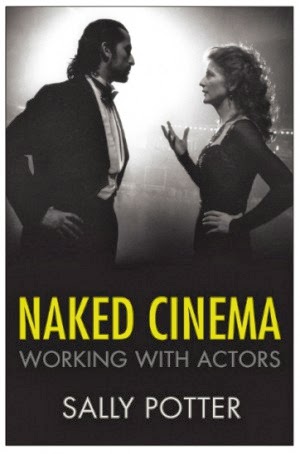
Her book Naked Cinema – Working with Actors is published this month. The book refers partly to the skeletal assets of performance on film. Actors are very reluctant to analyze what they do and how they do it and directors often like to keep their secrets. Breaking with this tradition is part of the process. The other part deals with the question of what embodiment is, what the nature of the fact that you’re dealing with layers of appearance and that you want to evoke that what you cannot see. She didn’t want to give anecdotes about the work in process as she experience it: “It’s a very precious and confidential partnership in which we do have a secret life.”












 ANNE •